On July 13, 2024, we had an inspiring expert talk of Prof. Dr. Mathias Niepert on Knowledge-Aware Generative Machine Learning in which he underlined the importance to combine generative machine learning models with domain knowledge.
Abstract:
Generative machine learning is often viewed as the task of learning to sample from complex data distributions. In many scientific and technical settings, however, this is not enough. We want models whose outputs can be controlled and whose behavior remains reliable when the desired output is rare and constrained.
This talk focused on methods for making generative models more controllable by combining learning with domain knowledge. One route is to build inductive biases directly into the model. For example, symmetries such as rotations can be encoded so that the model does not have to rediscover basic geometric structure from data alone. Such biases can improve generalization and make learned models more faithful to the systems they represent.
A second route is to steer generation with constraints that are too complex to encode as simple labels. These constraints may come from physical principles, design goals, or optimization problems. Prof. Niepert discussed how generative models, including diffusion-based models, can be guided by such constraints during sampling or training, allowing them to produce outputs that are not only plausible but also valid and useful.
Throughout the talk, Prof. Niepert used examples from machine learning for simulations and scientific modeling, while emphasizing that the underlying ideas apply more broadly. The central theme was that generative AI becomes more powerful when it is not treated as a purely data-driven sampler, but as a flexible model that can be guided by constraints and adapted to the requirements of the problem at hand.
Biography:
| Mathias Niepert is a professor at the University of Stuttgart and a faculty member of the International Max Planck Research School for Intelligent Systems (IMPRS-IS). He leads the Machine Learning and Simulation Lab, with affiliations to the Cluster of Excellence for Simulation Technology (SimTech), the Department of Computer Science, and the European Laboratory for Learning and Intelligent Systems (ELLIS). | 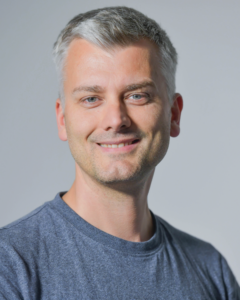 |
In addition to his academic roles, he serves as Chief Scientific Advisor at NEC Laboratories Europe, where he previously held positions as Chief Research Scientist and Manager of the Machine Learning Group.
Before joining NEC Labs, Mathias was a postdoctoral researcher at the Paul G. Allen School of Computer Science at the University of Washington, Seattle. He received his Ph.D. in Computer Science and Scientific Computing from Indiana University, USA.
His research focuses on efficient and controllable generative AI, geometric and physics-aware deep learning, probabilistic graphical models, and the intersection of machine learning, the natural sciences, and engineering. His group develops methods for learning and leveraging physical and geometric structure, with applications spanning computational chemistry, fluid dynamics, and biomedical research.
His work is regularly published in top-tier conferences such as NeurIPS, ICML, ICLR, AAAI, and UAI, and has received several best paper awards. Mathias is also a recipient of the Google Faculty Research Award and serves as Area Chair for leading conferences, including NeurIPS, ICML, and ICLR.